




 Chuck Loeb: Jazz Shredder Legend
By Brian Tarquin
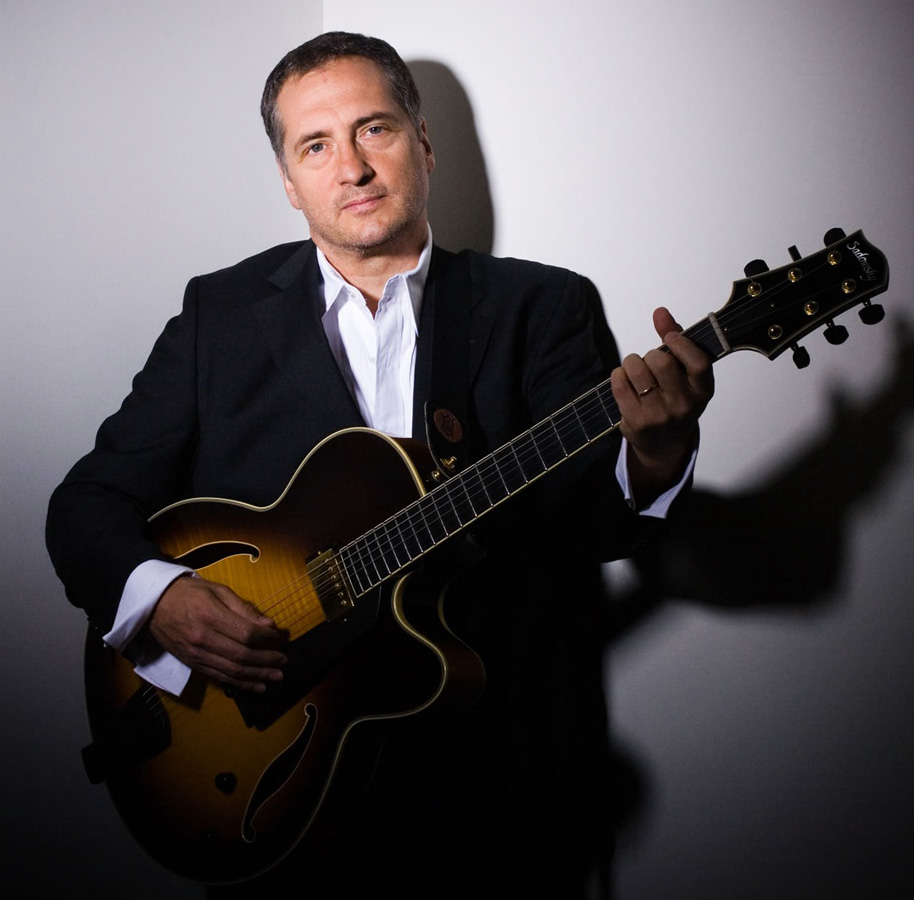
Chuck Loeb may not be a household guitar name; however, he has earned his weight in excellence as a jazz guitarist and studio musician. I first met Chuck Loeb 30 years ago when we were both playing the California Jazz Festival circuit with our bands. This was a much simpler time when the artist received a record deal, recorded an album, hopefully received radio airplay and toured. Back then I was a new artist performing at the Orange County Jazz Festival, Chuck was performing on the main stage and I was stuck off in the wilderness on the other side of the venue on a much smaller stage. At break time, when there was a mad dash for the food buffet, he came up to me and said he had heard my new single “One Arabian Knight” on Smooth Jazz radio and liked it. I was really taken back, because he was an established guitarist from Steps Ahead and for him to even acknowledge a song from a new young artist like me was a real honor. But that was the kind of guy he was, humble and supportive of his fellow musicians. He didn’t look upon us as rivals like many artists do, but as equals.
Chuck joined Steps Ahead in the mid 1980’s and appeared on three albums, Modern Times (1984), Magnetic (1986) and Yin Yang (1992). He then had a successful solo career and enjoyed many hits on Smooth Jazz radio through the years. In 2010 when Larry Carlton left the super group Fourplay, Chuck took over his guitar role and was with them until his passing. The 2014 album Jazz, Funk, Soul, featuring Chuck on guitar, Jeff Lorber on keyboards and Everette Harp on Sax, earned a Grammy nomination.
BTQ: For Fourplay what is your typical setup, guitar, amp, pedals, etc.?
Chuck: My Sadowsky guitars, of course: the solid body Strat model, the semi hollow with the
Bigsby bridge, and the Jazz Box. For the recording, I use a Roland GT-10 with a Xotic AC Plus Booster Over-drive pedal running stereo into two Fender Blues DeVille amplifiers. Also, on some things I go direct using the Line 6 Pod Farm and Amp Farm, depending on what the tune called for. Performing live, I use the Line 6 M13 Stompbox Modeler with a Moollon booster pedal in front. I also used Nathan East’s Martin 00018, a gift from Eric Clapton, on acoustic stuff and Mike Miller’s flamenco (no name) nylon.
BTQ: You have been a very successful solo jazz artist through the years. Can you tell us how working with a band like Fourplay changed your approach in making records and writing songs?
Chuck: Well, when thinking of each of the guys in the band, certain ideas sprang to mind when I
was writing my tunes. I have been a huge fan of both the group and the individuals for so
long, it was like falling off a log, really. One thing that impressed me was that of the four
songs I submitted to the project, the guys chose the most challenging and adventurous
ones. Then they killed on them. The biggest change for me is to be able to relax and let
others make the decisions sometimes. Fourplay is a truly democratic band.
 BTQ: On your solo recordings, what is your typical recording setup and how do you go about
recording your guitar tones?
Chuck: I do a lot of recording of guitar going direct and using plug-ins. As I mentioned, I like the Line 6 stuff a lot, but I also use Logic’s system and the Eleven stuff sometimes. I use amps, too, but my frame of reference is what Jaco Pastorius once said to me about his sound:
“It’s in your hands, man. The sound is really in the player s hands literally.”
BTQ: Do you have a favorite can’t live without guitar processor/effects?
Chuck: There are many, but I always go back to my CAE preamp for the super clean sound, and I have a mic pre called “Tube Top” from Japan. I love the Roland GT 10 and Line 6 M13
for quick and easy setups at live gigs and festivals, where we only get a line check. The
real world will make you a pragmatist quickly!
BTQ: Anything you’d like to add, any guitar recording tips or advice?
Chuck: Just the age-old advice: Play the guitar as much as you can, and after you’ve learned from the masters, do your best to find your own path to guitar enlightenment.
Oh, and one more thing: Don’t get too locked into one axe, or pedal, or amp whatever
works in any given situation is cool!
Conclusion:
In the world we live in today possessed by selfies, likes, views, hits and the abhorrent public obsession with social media, Chuck Loeb stood head and shoulders above the crowd as a consummate musician. And with his passing the music world has lost a great statesman of jazz guitar. I miss Chuck a lot as friend and a copatriot in the studio!

Multi-Emmy award winning Brian Tarquin is an established top rate composer/guitarist/producer. Through the past 30 years he has enjoyed Top 10 radio hits in several formats as Smooth Jazz, NACC Loud Rock, Roots Music Reports, Metal Contraband, Jam Band & CMJ’s RPM charts. His music has been heard by tens of millions on a plethora of television and film scores such as: CSI, Ellen, Extra, TMZ, 60 Minutes, Sex and the City, 20/20, SNL, Godzilla, Seinfeld, Cheers, Charmed, Good Morning America. He has recorded and produced such legends as Joe Satriani, Larry Coryell, Jean-Luc Ponty, Eric Johnson, Robben Ford, Steve Morse (Deep Purple) to name a few. In 2023 Brian’s music video “Speed of Sound” featuring Joe Satriani won Best Video of the Year by the Josie Music Awards.
linktr.ee/guitartrax
Share this post
Related
Posts

Featured Articles, Online Exclusives, Promotions, SFL Music Articles
GOV’T MULE – Warren Haynes
Interview