





 Unsung Hero: Steve Morse
By Brian Tarquin
Introduction
Steve Morse the American iconic rock fusion guitar pioneer was born July 28, 1954, in Ohio. His father was a minister, and his mother a classically trained pianist; in which Steve obviously received his musical genius. Like many budding musicians in the 70’s, Steve attended the University of Miami. Along with Andy West they formed the instrumental fusion group The Dixie Dregs. Morse is one of the most articulate and impressive guitarists of our generation. He was voted "Best Overall Guitarist" by Guitar Player magazine in their annual reader's poll five consecutive years (which ended his eligibility by retiring him into their "Gallery of Greats", a distinction shared only by Steve Howe of Yes.) I’ve had the privilege of working with Steve on several projects through the years and have collaborated with him on many albums as Fretworx, Guitars for Wounded Warriors, Vegas Blue and most recently Beyond the Warrior’s Eyes. He is a consummate musician and has an impeccable ear. It is always a pleasure working with Steve because of his wonderful arrangement suggestions. He also holds the honor of being the longest running guitarist in the band Deep Purple.
I was very inspired and influenced in college by his solo albums The Introduction and Stand Up. In 1984 I clearly remember the title song “The Introduction” when it was featured on the acetate sound page in Guitar Player magazine. I ran out and bought that album and was treated to the beautiful instrumental tracks “Cruise Missile”, “General Lee” featuring Albert Lee and “V.H.F. (Vertical Hair Factor)”. Then on his follow up album in 1985 Stand Up I discovered one of my favorite guitarists Eric Johnson featured on Steve’s song “Distant Star”.
Interview
BTQ: What's your set up with guitar and amps when recording?
Steve: My normal Musicman electric, a Buscarino acoustic/electric nylon string guitar, an Ovation steel string, a Steinberger 12 string, a Musicman baritone guitar (tuned down to B), and a Line 6 Variax too. I'm enjoying the new signature amp that ENGL made for me, and a stock ENGL classic tube amp.
BTQ: Do you have your own studio, or do you use an outside studio for your recordings?
Steve: I use my studio. It's a very modest endeavor, built for space rather than sonic perfection. There are some concessions to recording ideas such as no parallel walls, slightly higher ceiling, and walls separated from the floor by foam.......but it's pretty simple compared to the professionally designed ones I've seen in some musician's homes. I've become attached to my old board, which is still wired to my old Studer 24 track, so everything went through the board on it's way to being recorded by the computer. The old Urei compressors still work, and are used on all vocals and clean guitars.
BTQ: How do you record guitars, mics, room amp or close mic, etc?
Steve: I close mic'd everything, using a large diaphragm Shure KSM condenser and a Neuman 47 for the voice. I tried lots of mics for the acoustics, and probably used the Shure 81 the most. I also used a tube direct going into the Urei 1176 compressor for direct stuff.
BTQ: What format do you record songs on, analog or digital?
Steve: I use Cubase SX1, 2, and 3. Cubase is very powerful and fits my needs fine. I find the German approach easy to understand and remember......after making some mistakes in the beginning, years ago. All software like this requires quite a ramp-up period of time to learn what to do. Basically, you have to be able to edit almost everything on the fly, or have a superhuman memory and 'fix it later'.
My computer is a plain vanilla, electronics outlet HP desktop. Years ago, I used Apple stuff, but when my Mac fried, there was literally no place in town to get another and get back to work, so I made the big jump to PC stuff, which led me right to Cubase. Mark of the Unicorn A to D converters, and a few random keyboards I have around, and that was it.
BTQ: Being a guitarist, what foot pedals do you use?
Steve: I usually don't use pedals in the studio. One technique I have used was to double a part with the effect, say a chorus delay, on the opposite side of the dry part. Then, when you double the part, pan the doubled part exactly opposite so that on take one you have dry on the left, effect on the right...........take two you have dry on the right, effect on the left. It makes it sound sonically complex without totally phasing out. The doubles need to be pretty close to make that work, since it's best if they are the same volume.
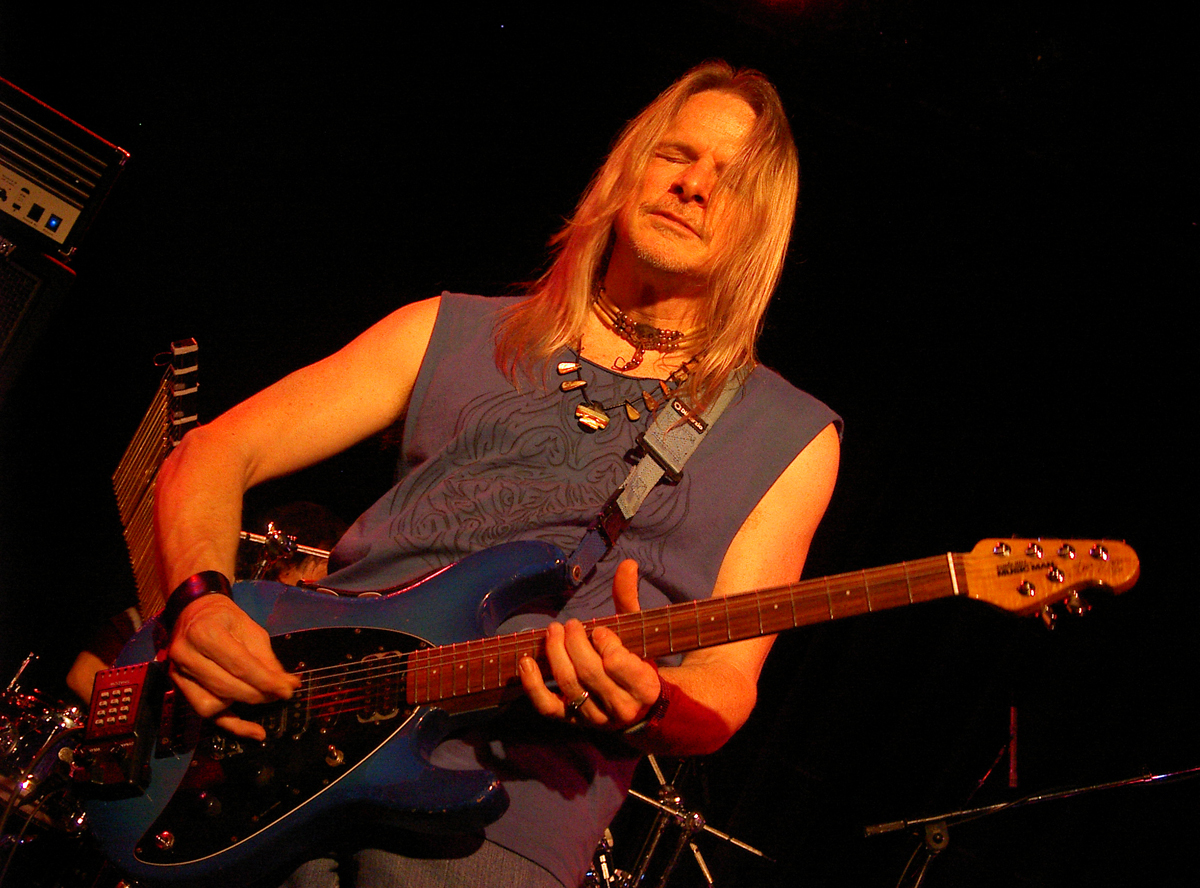 BTQ: Can you explain how Steen Skrydstrup modified your amp rig with the ENGLS and how that has affected your sound?
Steve: The biggest way it's affected my sound is that my rig never breaks during shows! It's a great example of industrial quality trumping consumer quality. With my usual fat snake of long guitar cords, I could always rewire and troubleshoot any part of the rig. However, in this context, with limited time to set up, and lots of traffic on the cords, this heavy-duty multi-pin approach is easier to set up...........and amazingly, very reliable. In case you haven't guessed, I haven't had 100% luck with multi-pin systems in the past, but his work seems to be impeccable. I feel very fortunate to have a rig of such high quality from the guitar all the way to the speakers.
Conclusion
I love to see our old school guitar heroes incorporate the new digital recording technology with the classic analog recording techniques we all know and love. This is something that is near and dear to my heart. Since I come from the old days of analog myself, I’ve always felt strongly that digital recording needs the warmth of an analog mixer and vintage compressors to enhance the signal flow. This is exactly how Steve and I worked together on the instrumental tracks such as “Towers”, “Distant Light”, “Battalion”, “Faith & Hope” to name a few.
I recorded all the tracks on my Otari MTR 90 2-inch analog tape machine and then bounced them down to Logic Pro X or Pro Tools. So, when Steve sent me his solo tracks, I just flew them in the session and lined them up and mixed. I’m a strong believer that both digital and analog worlds compliment each other very well. I even encourage budding recording engineers who solely live in the box to go out and buy an analog ¼” 2-track tape machine to use for master mix downs to warm up the signal. Once properly aligned, you’d be very surprised how that makes a sonic difference!

Multi-Emmy award winning Brian Tarquin is an established top rate composer/guitarist/producer. Through the past 30 years he has enjoyed Top 10 radio hits in several formats as Smooth Jazz, NACC Loud Rock, Roots Music Reports, Metal Contraband, Jam Band & CMJ’s RPM charts. His music has been heard by tens of millions on a plethora of television and film scores such as: CSI, Ellen, Extra, TMZ, 60 Minutes, Sex and the City, 20/20, SNL, Godzilla, Seinfeld, Cheers, Charmed, Good Morning America. He has recorded and produced such legends as Joe Satriani, Larry Coryell, Jean-Luc Ponty, Eric Johnson, Robben Ford, Steve Morse (Deep Purple) to name a few. In 2023 Brian’s music video “Speed of Sound” featuring Joe Satriani won Best Video of the Year by the Josie Music Awards.
linktr.ee/guitartrax
Share this post
Related
Posts


Featured Articles, Reviews, SFL Music Articles
Jason Bonham’s Led Zeppelin Experience
Concert Review